# Ushuaia landfill: the suspected contamination site of the MV Hondius index case
> On 27 March 2026, Leo and Mirjam Schilperoord visited a landfill 6 km from Ushuaia to see Darwin's caracara. The leading — but contested — hypothesis.
Published on May 12, 2026 on HantaTracker
Canonical source: https://hantatracker.fr/en/articles/ushuaia-landfill-index-case/
Category: Investigation
When the international press identified, on 11 May 2026, **Leo Schilperoord**, a 70-year-old Dutch ornithologist, as the **index case** of the MV Hondius hantavirus outbreak, attention immediately turned to an unlikely place: a **municipal landfill 6 km from Ushuaia**. Why this site, why this date, why this couple? And why is Argentina refusing, at this stage, to admit that this is where it all began?
## 27 March 2026: the visit
According to information gathered by the international press, Leo and his wife **Mirjam Schilperoord** spent several months travelling across South America between late 2025 and spring 2026. Argentina, Chile, Uruguay, then back to Argentina in late March for what was meant to be a final stop before joining the MV Hondius at **Ushuaia, in Tierra del Fuego**, on 1 April.
On **27 March 2026**, five days before boarding, the couple visited the **Ushuaia municipal landfill**, located about 6 km north-west of the city. This is one of the last documented birding observations of the couple before boarding.
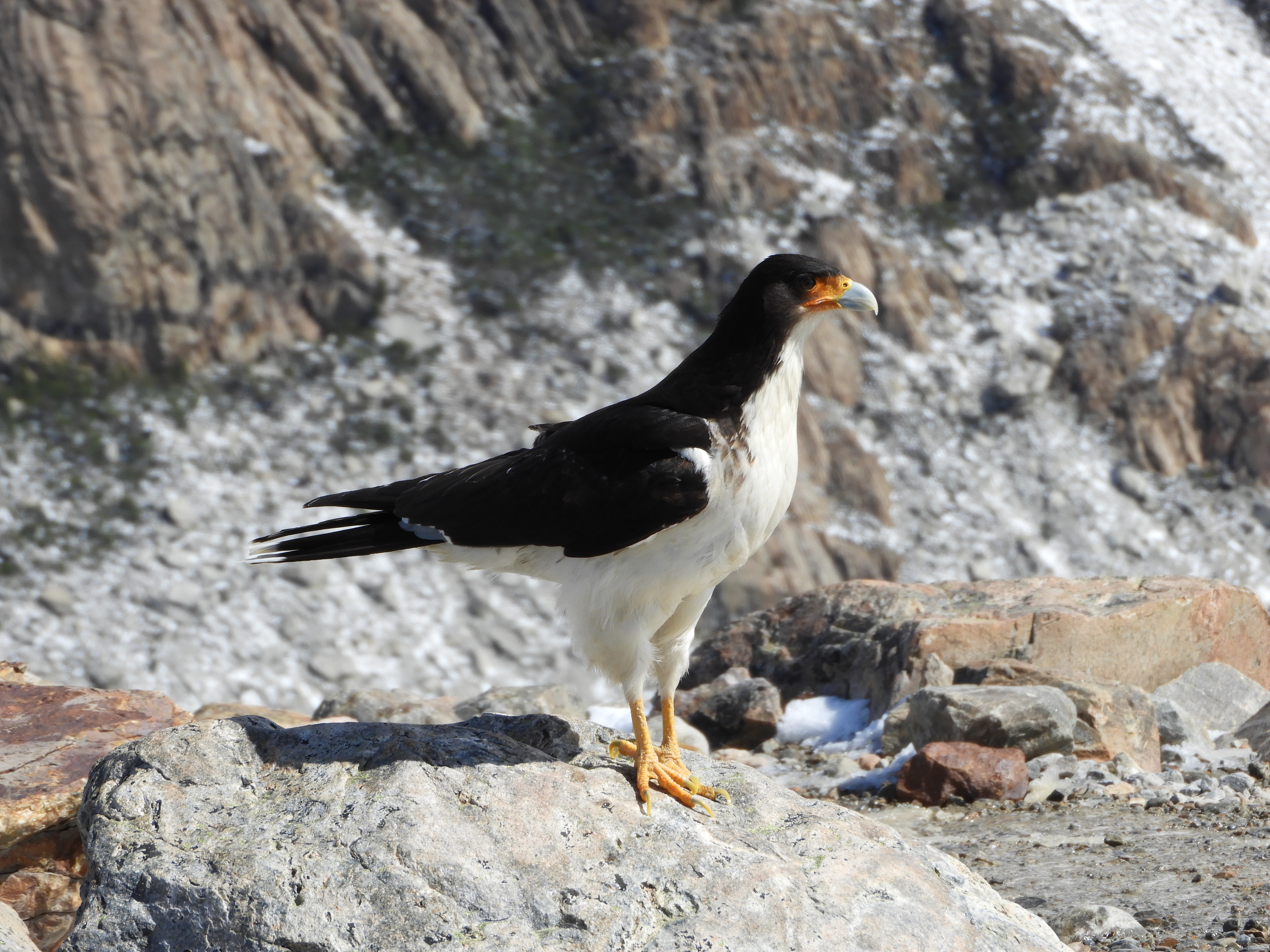
White-throated caracara (Phalcoboenus albogularis), also known as Darwin's caracara, in Los Glaciares National Park (Argentina). The species birders come to observe at the Ushuaia landfill. Photo: Raf24, Wikimedia Commons, CC BY 4.0.
## Why this landfill draws birders from around the world
At first glance, the choice of destination seems odd. But for ornithologists specialised in South American raptors, the site is a **pilgrimage destination**. It hosts an exceptional concentration of **white-throated caracaras** (*Phalcoboenus albogularis*), also known as **Darwin's caracara** — a falconiform raptor endemic to southern Patagonia, southern Chile, and Tierra del Fuego.
Why would a raptor congregate at a landfill? The white-throated caracara is an **opportunistic scavenger**. Like other caracaras, it feeds on animal remains, organic waste, and occasionally small live rodents. Patagonian landfills act as **artificial habitats** with concentrated, accessible food, making them particularly productive observation sites for amateur and professional birders.
## The contamination hypothesis
Argentine investigators and the international press converge on the following hypothesis: **the Schilperoords inhaled aerosols contaminated** by the droppings of rodents present at the site.
The proposed mechanism is classic for hantavirus diseases:
1. **Reservoir rodents** live in the landfill, drawn by organic waste
2. They shed the virus in their **urine, faeces and saliva** without showing symptoms
3. When these droppings **dry and mix with dust**, viral particles become airborne
4. Inhalation of these aerosols, especially during prolonged exploration of a densely populated site, can be enough to cause infection
The Andes virus incubation period — between 7 and 42 days — matches the observed timeline perfectly: exposure on 27 March, first symptoms on **6 April**, death on **11 April**.
## But this hypothesis is contested — strongly
As early as 8 May 2026, **Juan Facundo Petrina**, Director General of Epidemiology and Environmental Health for the province of Tierra del Fuego, **publicly rejected** the idea that Ushuaia is the origin of the outbreak. His arguments are precise:
1. **No human hantavirus case** has ever been recorded in Ushuaia or in the Tierra del Fuego region, neither recently nor historically.
2. **Ushuaia lies about 1,500 km south** of the documented range of the subspecies of *Oligoryzomys longicaudatus* (the **long-tailed pygmy rice rat** or colilargo) known to carry Andes virus.
3. **No veterinary investigation** of local rodents has, to date, detected the presence of Andes virus or a related strain.
The global birding community has also pushed back: based on reporting by NBC News, several professional ornithologists recall that the Ushuaia landfill is visited every year by hundreds of international guests, **without any hantavirus case reported** so far. Branding Ushuaia a health-risk site would, in their view, be **disproportionate**.
## A science still incomplete
This divergence opens several leads that the international epidemiological investigation must clarify:
- Could **another rodent species** present in Tierra del Fuego carry a related, as-yet-undescribed hantavirus strain?
- Could a **recent range extension** of the long-tailed pygmy rice rat, linked to climate change, explain an unusual presence so far south?
- Is **exposure elsewhere in South America** during the previous months — at another stop of the couple's journey in Argentina, Chile or Uruguay — plausible?
On **5 May 2026**, the **Swiss National Reference Centre for Emerging Viral Infections** published the **whole-genome sequencing** of the virus from the Swiss case (Case 7). The virus belongs to the **Andes strain**, genetically very close to the Argentine **Epuyén 2018-2019 outbreak**, with no unusual mutation or documented recombination. This result supports a **classic South American origin** of the virus, without however settling the question of the exact site of exposure.
## The Schilperoords, passionate birders
Public identification of the index case was made possible by the decision of Dutch health authorities and statements from the couple's relatives. Leo Schilperoord, 70, and his wife **Mirjam Schilperoord**, 69, were amateur ornithologists recognised in the Dutch and international birding community. Their multi-month trip to South America was the realisation of a long-standing project.
Mirjam Schilperoord left the MV Hondius on **24 April** at Saint Helena, accompanying her husband's body. She fell ill a few days later, taken into emergency care in South Africa after the Saint Helena → Johannesburg flight on **25 April**. She died in Johannesburg on **26 April 2026**. Her case was initially classified probable, then confirmed by PCR on 3 May.
The couple, publicly identified by their relatives as well as by the authorities, is documented here with respect for family dignity. All information cited is drawn from established press sources (Newsweek, Euronews, NBC News, Infobae, IOL) and official statements.
## Key takeaways
- The **Ushuaia landfill visit on 27 March 2026** by the Schilperoords is currently the **leading hypothesis** held by international investigators.
- This hypothesis is **not confirmed**: Argentine authorities in Tierra del Fuego **reject** it, citing the historical absence of the virus in the region and the distance from the known reservoir rodent's range.
- The **Swiss sequencing** points to a classic South American origin, but does not settle the exact location.
- The **investigation is ongoing** by Argentine authorities, France's COREB mission and the **CNR Hantavirus** (Institut Pasteur), in coordination with the **WHO** and **ECDC**.
To understand the precise role of reservoir rodents in Andes virus transmission, see our article on the [long-tailed pygmy rice rat, reservoir of Andes virus](/en/articles/andes-virus-rodent-reservoir/). For the complete case timeline, see our [timeline page](/en/timeline/).